Art and Science Programme
Hurst Lodge Art and Science Programme
The Art & Science Programme at Hurst Lodge School is an interdisciplinary Programme that connects artistic practice, scientific exploration, and inclusive education. Designed and led by Laura Benetton, Art and Science Coordinator at Hurst Lodge School, the programme invites students with Special Educational Needs (SEN) to explore the natural world through both scientific observation and creative expression.
Working in partnership with institutions including the Natural History Museum, the Angela Marmont Centre for UK Biodiversity, and Birkbeck University of London, students engage in hands-on workshops, microscopy sessions, specimen studies, and collaborative research projects.
By looking closely at nature, from butterfly wings to microscopic structures, students develop original artworks while discovering how patterns, colour, and light connect art and science.
Mission
The mission of the Hurst Lodge Art & Science Programme is to create a learning environment where scientific curiosity and artistic creativity reinforce one another, allowing students to explore the natural world through observation, experimentation, and making.
Through collaborations with museums, researchers, and universities, the programme provides students with opportunities to engage deeply with complex ideas in ways that support focus, curiosity, and creative confidence.
By combining biology, microscopy, art practice, and research, the programme aims to nurture new ways of learning where science becomes visible through art and art becomes a tool for discovery.
Current Project “Hyperfocus Lab”: The Art of Obsession and Light (2025–2026)
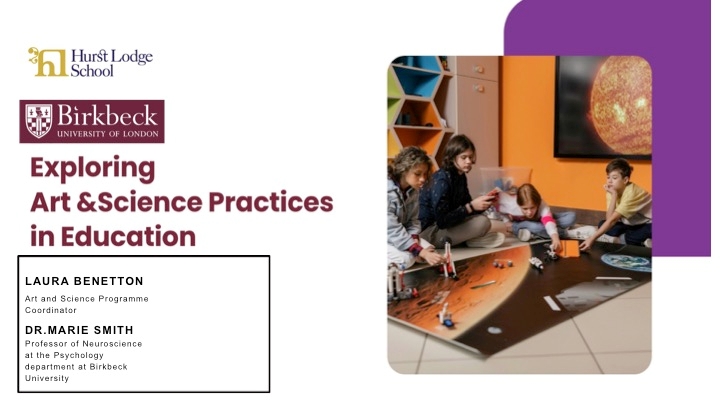
The current research project within the programme is “Hyperfocus Lab ” The Art of Obsession and Light, developed in partnership with Birkbeck University of London.
Led by Laura Benetton in collaboration with Dr. Marie Smith, the project runs from December 2025 to July 2026 and is designed for autistic students aged 13–14 with strong creative abilities and the capacity for deep concentration.
Programme Concept
Many autistic individuals demonstrate exceptional abilities in pattern recognition, detail perception, and sustained hyperfocus. Hyperfocus Lab transforms these strengths into a structured artistic practice where students can channel intense concentration into highly detailed, pattern-based artworks.
Participants explore artistic processes involving light, repetition, structure, and biological patterns, often inspired by natural forms such as insect wings, cellular structures, and microscopic systems.
Art, Science and Research
The project combines creative practice with scientific research. While students work on their artworks, researchers from Birkbeck University observe and analyse how sustained artistic engagement influences:
Attention and hyperfocus
Emotional regulation
Cognitive processes
Social Interaction and collaboration
The research is informed by areas including neuro aesthetics, sensory integration, and Flow Theory, which examines how deep concentration and creativity can produce optimal learning experiences.
Final Installation
At the end of the programme, students will collaborate on a large-scale art installation that brings together their individual works into a unified environment exploring light, pattern, and perception.
The installation will reflect both the creative development of the students and the insights gained through the research partnership.
Programme Highlights – 2024/2025
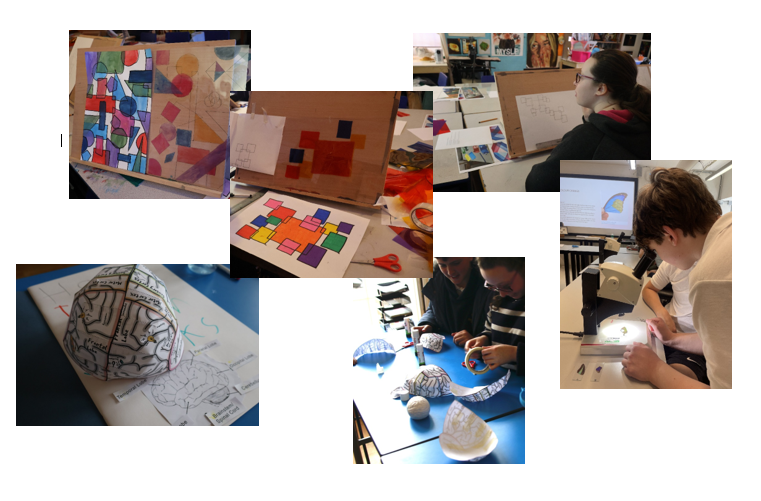
During the first year of the programme, students participated in a range of workshops and collaborative learning experiences focused on entomology, colour, and biological structures.
Workshops with the Natural History Museum
Students took part in two special workshops led by Alessandro Giusti, Curator of the Lepidoptera department at the Natural History Museum. These sessions explored the extraordinary diversity of butterflies and insects, with a particular focus on colour and structural patterns in wings.
Students investigated how colour can emerge not only from pigments but also from microscopic structures. Through experiments inspired by the Morpho butterfly, they explored the concept of structural colour and bioluminescence, linking scientific observation with creative experimentation.
Angela Marmont Centre Visit
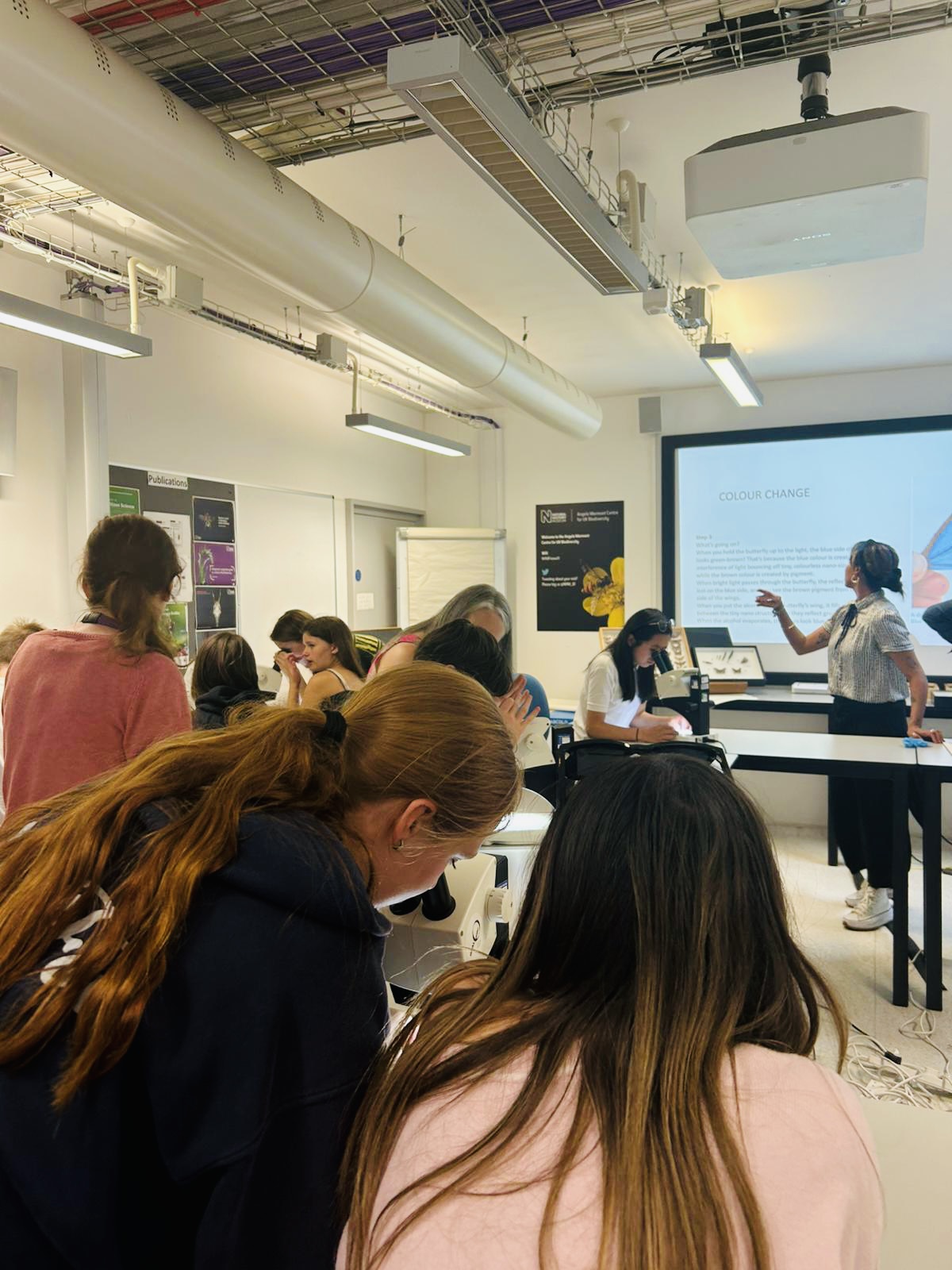
Students also visited the Angela Marmont Centre for UK Biodiversity, where they attended a lecture delivered by Laura Benetton and Alessandro Giusti introducing the scientific and artistic perspectives behind the project.
This was followed by a hands-on microscopy workshop, where students examined different species and closely analysed the microscopic structure of butterfly wings and colour patterns. These observations became the starting point for future creative studies and artworks.
Big Butterfly Day
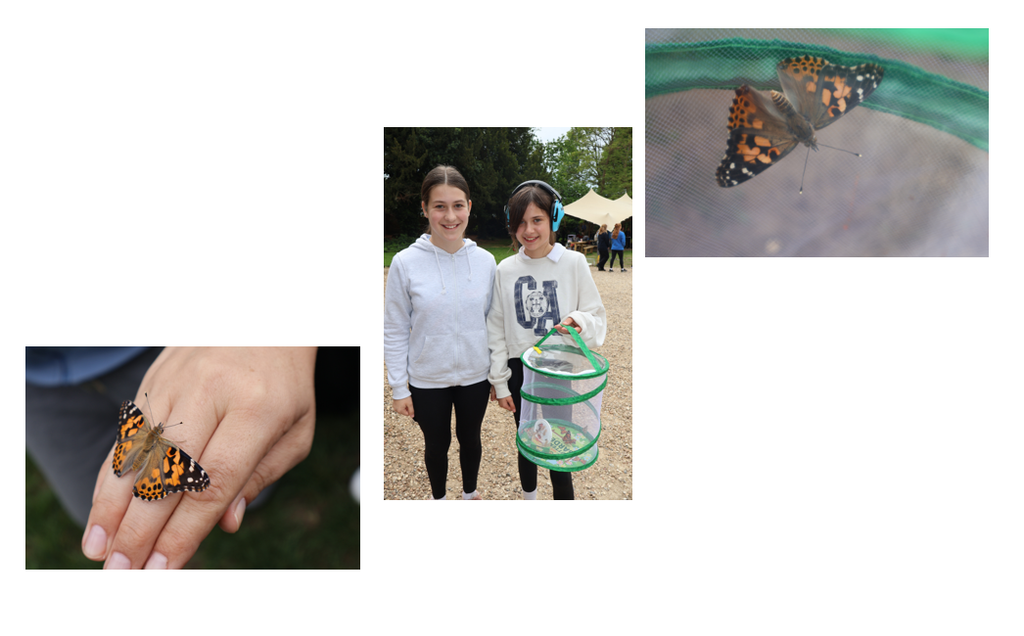
As part of a biological observation project, students bred over 40 Painted Lady butterflies within the school. The life cycle of the butterflies—from caterpillar to chrysalis to adult—became an opportunity to study metamorphosis and transformation.
The project culminated in our “Big Butterfly’s Day Release” , when the butterflies were released in the school grounds in front of Yateley Hall, celebrating both the scientific journey and the students’ creative work inspired by the process.